Thinking about installing a 5kW solar system in Pakistan but unsure whether the investment is worth it?
You’re not alone. With electricity costs putting pressure on household budgets, many homeowners are exploring solar energy to reduce their monthly bills and gain greater control over long-term energy expenses.
A 5kW solar system can be an attractive option for households with moderate electricity consumption. However, the total installation cost, monthly savings, and return on investment depend on factors such as panel quality, system type, electricity usage, and local tariffs.
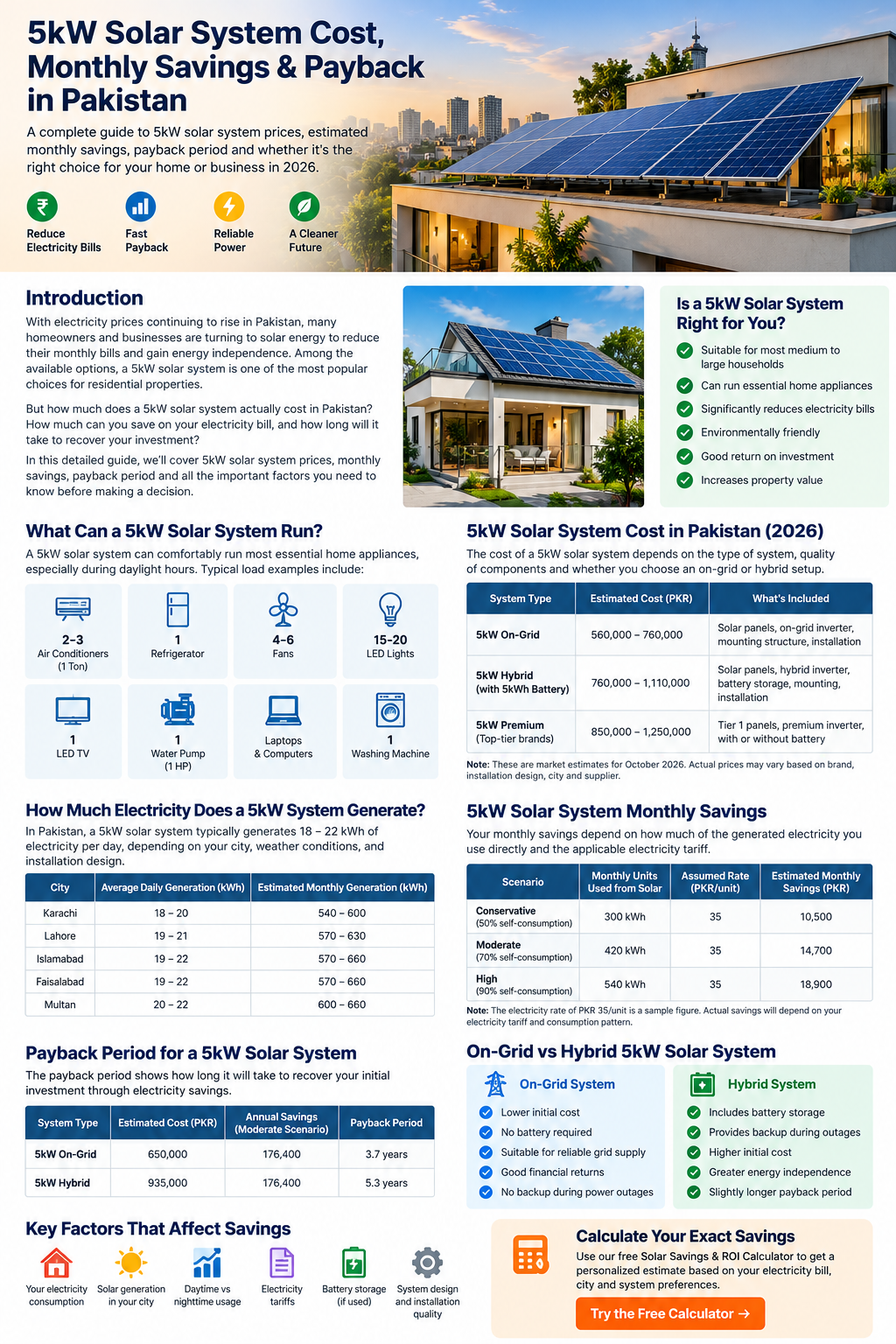
Quick Answer: In October 2026, a typical 5kW on-grid solar system in Pakistan may cost approximately PKR 560,000 to 760,000, based on current component-based market estimates. A hybrid system with battery storage may cost approximately PKR 760,000 to 1,110,000. These are indicative ranges rather than fixed installation quotations.
A properly installed 5kW system may generate roughly 500–750 electricity units (kWh) per month, depending on location, season, shading, equipment and operating conditions.
But how much money will you actually save?
Let’s explore the real cost, electricity production, savings, and expected payback period of a 5kW solar system in Pakistan.
Want to calculate your own savings?
Try the Free Solar Savings & ROI Calculator by Mahendus Power Solution
A 5kW solar system is a photovoltaic electricity generation setup with approximately 5 kilowatts of installed solar panel capacity.
It converts sunlight into electricity using solar panels and an inverter.
A typical residential system includes:
Solar panels with approximately 5kW of total rated capacity
An on-grid or hybrid solar inverter
Rooftop mounting structures
DC and AC cables
Electrical protection equipment
Installation and commissioning
Optional battery storage for backup power
Depending on the wattage of each panel, a system may use approximately nine 585W solar panels, giving a total nominal panel capacity of 5.265kW.
The term 5kW refers to rated power capacity under standard testing conditions. It does not mean that the system will continuously produce 5kW throughout the day.
Actual production changes with sunlight intensity, temperature, shading, and system efficiency.
The cost of a 5kW solar system depends primarily on whether you select an on-grid or hybrid installation.
| System Type | Indicative Price |
|---|---|
| 5kW On-Grid Solar System | PKR 560,000–760,000 |
| 5kW Hybrid Solar System with approximately 5kWh Battery | PKR 760,000–1,110,000 |
These estimates are based on October 2026 published market assessments. Individual installer prices vary, and quotations may include different brands, equipment and installation services.
The total investment generally covers:
Solar Panels
Solar panels are responsible for generating electricity from sunlight. Their price varies by manufacturer, power rating, efficiency, warranty, and product availability.
Solar Inverter
An inverter converts the DC electricity produced by solar panels into AC electricity used by household appliances.
An on-grid inverter normally works with the utility grid, while a compatible hybrid inverter can manage solar generation and battery storage.
Mounting Structure
A suitable mounting structure secures the panels and supports the required orientation and tilt.
Wiring and Protection
Electrical protection devices, appropriate cable sizing, breakers and other components are essential for reliable and safe operation.
Installation and Testing
Professional installation includes equipment fitting, electrical connections, system testing, and commissioning.
Battery Storage (Optional)
A hybrid solar system can include a battery for storing electricity and providing backup power when the grid is unavailable.
Battery capacity should be chosen according to the appliances you need to operate and the backup duration required.
Two 5kW solar quotations can differ significantly because of:
Solar panel brands and warranties
Inverter quality and capacity
Battery technology and storage size
Rooftop height and structure requirements
Wiring distances
Electrical protection equipment
Installation complexity
Grid connection and approval requirements
After-sales support
Always compare detailed itemized quotations instead of choosing a system solely on its advertised price.
A common question among homeowners is:
How many electricity units can a 5kW solar system produce in Pakistan?
Solar electricity is measured in kilowatt-hours (kWh), commonly referred to as electricity units.
The output of a solar system depends on sunlight availability, panel performance, ambient temperature, system losses, and installation quality.
For initial planning, a 5kW system might produce approximately 500–750 kWh in a month under suitable conditions. This is a broad illustrative range, not a guaranteed output.
| Generation Scenario | Daily Average | Monthly Total (30 Days) |
|---|---|---|
| Lower production | 16.7 kWh | 501 units |
| Moderate production | 20 kWh | 600 units |
| Higher production | 25 kWh | 750 units |
Summer and winter production will differ. A system may perform better during periods with longer effective sunlight hours, although high panel temperatures can also reduce efficiency.
Monsoon clouds, dust, shading, and equipment conditions affect actual electricity generation.
For more accurate output projections, use location-specific solar irradiance data and a professional site assessment.
A solar system’s electricity generation and financial savings are not the same thing.
You save money when solar energy replaces electricity you would otherwise purchase from the utility, or when eligible exported electricity earns a credit.
The amount saved depends on how much power is consumed directly and the applicable import and export tariffs.
Consider a household with the following assumptions:
| Factor | Example |
|---|---|
| Solar system size | 5kW |
| Monthly generation | 600 units |
| Direct solar self-consumption | 70% |
| Electricity consumed directly | 420 units |
| Electricity exported or otherwise unused | 180 units |
| Assumed avoided grid rate | PKR 35/unit |
| Monthly direct-consumption savings | PKR 14,700 |
| Annual direct-consumption savings | PKR 176,400 |
In this example:
420 × PKR 35 = PKR 14,700 in estimated monthly savings.
These figures represent electricity savings from direct solar consumption only.
The 180 remaining units may provide an additional financial benefit if exported under an eligible grid arrangement, but their value depends on the applicable regulations and agreement.
The assumed PKR 35 electricity rate is used for illustration and does not represent a universal tariff for all Pakistani customers.
Yes.
For example, if a homeowner uses more solar electricity during daylight hours, the amount of grid electricity purchased may decrease further.
On the other hand, households with limited daytime consumption may export a larger share of electricity at a lower financial value.
This is why solar consumption patterns are just as important as installed system size.
The payback period is the estimated time needed for solar savings to recover the original investment.
The simplified formula is:
Payback Period = Total Installation Cost ÷ Annual Net Savings
Assume:
Installation cost: PKR 650,000
Estimated monthly direct-consumption savings: PKR 14,700
Estimated annual savings: PKR 176,400
Calculation:
650,000 ÷ 176,400 = approximately 3.7 years
This means that under the stated assumptions, the solar system could recover its initial investment in approximately 3 years and 8 months.
However, this simplified calculation excludes equipment replacement, maintenance, financing expenses, and future changes in generation and electricity prices.
Assuming an installation cost of PKR 650,000:
| Monthly Net Savings | Annual Net Savings | Simple Payback |
|---|---|---|
| PKR 10,000 | PKR 120,000 | 5.4 years |
| PKR 12,500 | PKR 150,000 | 4.3 years |
| PKR 15,000 | PKR 180,000 | 3.6 years |
| PKR 18,000 | PKR 216,000 | 3.0 years |
| PKR 20,000 | PKR 240,000 | 2.7 years |
These are mathematical scenarios, not guaranteed savings predictions.
Your actual payback period may vary depending on consumption, electricity tariffs, system efficiency, maintenance, and regulatory conditions.
Instead of relying on generalized estimates, use the Mahendus Solar Savings & ROI Calculator to compare system costs, savings, and expected returns.
The best solar setup depends on your priorities.
Some homeowners want to minimize electricity bills, while others also need backup power during load shedding.
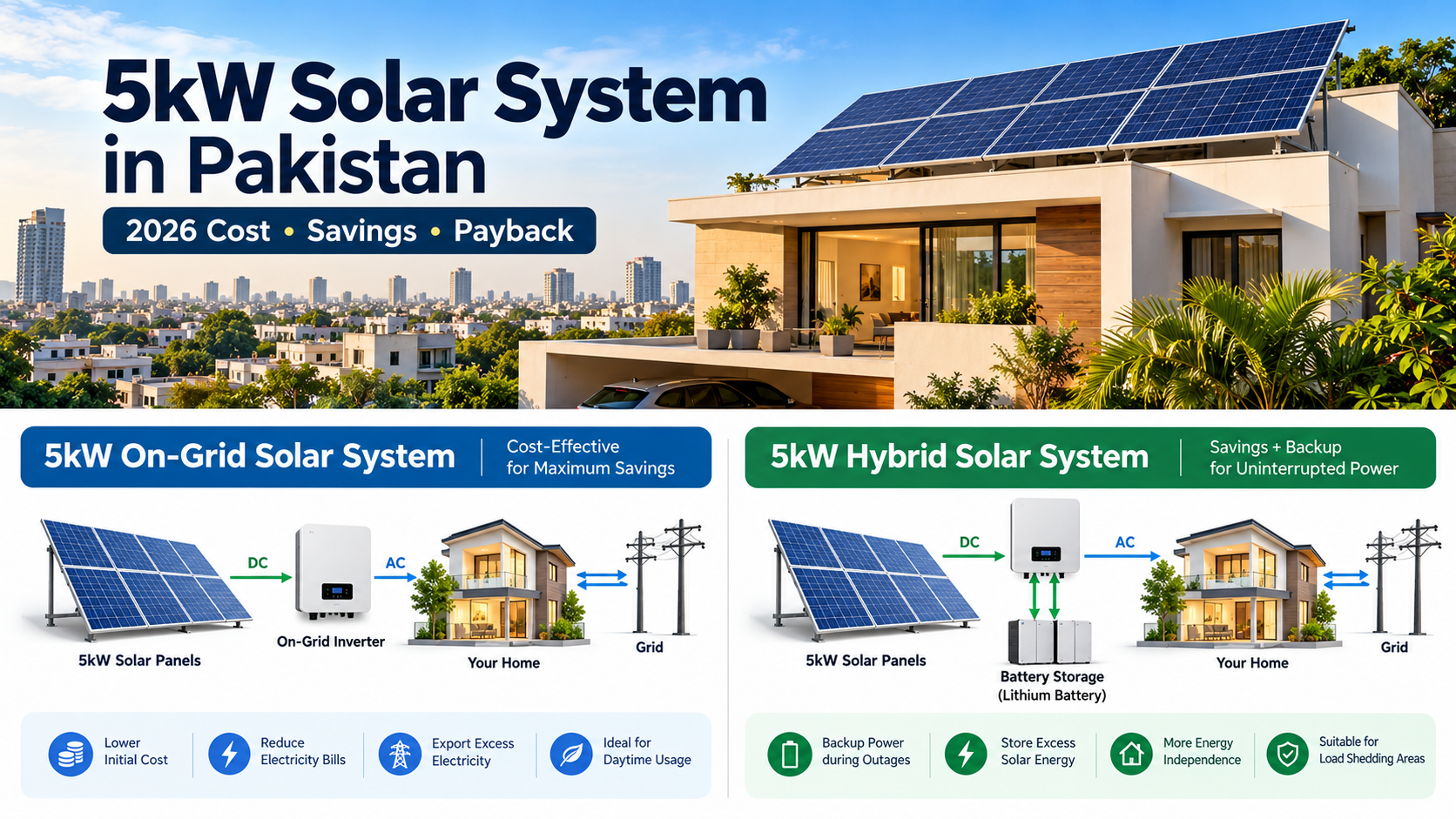
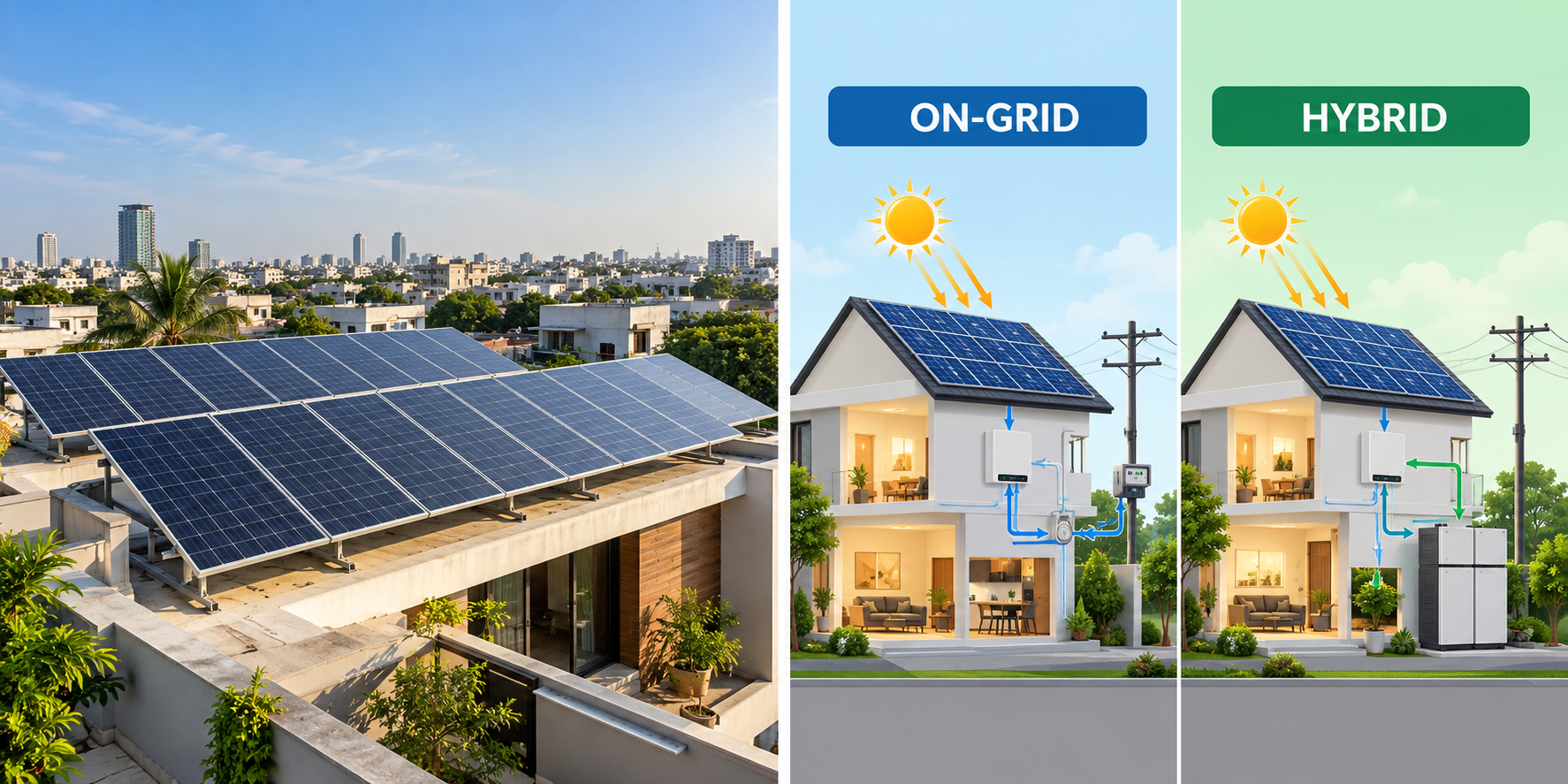
An on-grid solar system is connected to the electricity grid.
Its main advantage is a generally lower installation cost because it does not require battery storage.
Advantages:
Lower initial investment
No battery replacement costs
Reduced grid electricity consumption during daytime
Potential export credits where eligible
Relatively simple maintenance
Limitations:
A standard grid-tied system generally shuts down during utility outages.
Electricity is still needed from the grid when solar generation is insufficient.
Exported electricity is subject to applicable tariff and regulatory conditions.
A hybrid system combines solar generation with an inverter capable of managing battery storage.
Advantages:
Backup power during load shedding when appropriately configured
Ability to store electricity for later use
Greater flexibility in managing daytime and nighttime consumption
Reduced dependence on the grid for selected essential appliances
Limitations:
Higher initial investment
Battery replacement may eventually be necessary
Energy losses occur when charging and discharging batteries
Additional equipment and maintenance complexity
| Feature | On-Grid | Hybrid |
|---|---|---|
| Initial investment | Lower | Higher |
| Battery storage | Not required | Usually included |
| Backup during power outage | No | Yes, when configured |
| Equipment complexity | Lower | Higher |
| Battery replacement expense | No | Possible |
| Ideal purpose | Lower electricity costs | Savings and backup |
If your electricity supply is reliable and your main objective is reducing electricity expenses, an on-grid system may be more economical.
If you frequently experience power outages, a hybrid system may offer greater practical value even if its financial payback period is longer.
Yes, a properly designed 5kW solar system can support an inverter air conditioner along with selected household appliances, provided total instantaneous demand remains within the available output and inverter limits.
However, the number of appliances it can operate depends on their actual power requirements.
For example:
| Appliance | Illustrative Running Power |
|---|---|
| Inverter AC | 900–1,800W |
| Refrigerator | 100–250W |
| Ceiling fan | 50–90W |
| LED lights (combined) | 40–100W |
| Television | 60–150W |
| Internet router | 10–20W |
These figures are approximate; specific products may consume significantly more or less.
A 5kW solar system does not necessarily provide 5,000 watts throughout the day.
Cloud cover, heat, shading, and seasonal conditions can reduce available output.
Motor startup loads and inverter surge capacity should also be considered.
For backup during outages, battery size and inverter output capacity are equally important.
Roof area depends on panel dimensions, layout, spacing, orientation, and maintenance access.
As a general planning estimate, a 5kW installation may require approximately 250–400 square feet of usable rooftop area.
However, this is not a fixed requirement.
Panel wattage, mounting structure, building obstacles, and the need to avoid shading can change the total space needed.
A qualified solar installer should inspect your rooftop before recommending the final layout.
Pakistan introduced the NEPRA Prosumer Regulations in February 2026, followed by amendments in April and August.
The applicable net-billing framework affects the value of electricity exported to the grid.
For new eligible installations, imported and exported electricity are accounted for under the applicable regulatory arrangement rather than assuming every exported unit offsets one imported unit at the same retail value.
This makes direct solar consumption particularly important.
Imagine two homes with identical 5kW solar systems.
Household A:
Uses a large portion of solar electricity directly for air conditioning, refrigeration, water pumping, and other daytime activities.
Household B:
Uses relatively little electricity during the day and purchases more electricity from the grid at night.
Even if both solar systems generate the same amount of electricity, Household A may obtain greater financial value from its generation.
The exact difference depends on the applicable import tariffs, export credits, and billing arrangements.
Before installing solar, confirm current connection requirements and the rules applicable to your electricity distribution company.
Existing approved agreements may also have different provisions from new installations.
Installing solar panels is only the first step. Your energy consumption habits can influence long-term returns.
Where practical, schedule flexible electricity consumption during periods of strong solar generation.
For example, operate washing machines, water pumps, and other suitable appliances during the day.
Reliable panels, inverters, protection devices, and installation materials help support long-term performance.
Compare warranties and after-sales service instead of selecting equipment solely on price.
Dust accumulation and shade can reduce output.
Follow a safe maintenance schedule recommended by your installer.
A larger system may produce more electricity than you can directly use.
Under a net-billing arrangement, that additional generation may not provide the same financial return as direct consumption.
Select capacity based on actual electricity usage, rooftop conditions, and future needs.
Battery storage provides practical value where power outages are common.
However, its initial cost, usable capacity, charging losses, and replacement needs should be included when calculating ROI.
A 5kW solar system can be a worthwhile investment for households with sufficient daytime electricity demand, suitable rooftop space, and a properly designed installation.
The most attractive financial results generally occur when a significant portion of solar generation is used directly.
However, not every household will achieve the same savings.
A family that consumes relatively little electricity during daylight hours may experience a longer payback period than a household using air conditioning and other appliances during the day.
Similarly, homeowners who require extensive battery backup may face higher upfront costs.
Before making an investment, consider the complete financial picture rather than focusing only on advertised monthly bill savings.
An indicative October 2026 price range for a 5kW on-grid installation is approximately PKR 560,000–760,000. Hybrid systems with battery storage generally cost more. Actual quotes depend on equipment and installation requirements.
For initial planning, approximately 500–750 units per month may be used as an illustrative range under suitable conditions. Actual production varies by location, season, system orientation, temperature, and shading.
Savings depend on direct solar consumption, electricity rates, exports and billing arrangements. Under one illustrative scenario involving 420 directly consumed solar units and an avoided rate of PKR 35 per unit, monthly savings would be PKR 14,700.
Payback depends on installation costs and annual net savings. For example, a PKR 650,000 system delivering PKR 176,400 in annual savings would have a simplified payback period of approximately 3.7 years.
It may support two efficient inverter ACs under suitable conditions, but this depends on their combined consumption, other running appliances, available solar generation, and inverter capacity. A detailed load assessment is recommended.
Hybrid is useful for backup power, while on-grid generally costs less. The better option depends on your electricity reliability requirements and financial priorities.
A system can use approximately nine 585W panels, giving 5.265kW of rated panel capacity. Panel counts vary with wattage and design.
Grid export eligibility depends on applicable NEPRA regulations, technical requirements and utility approval. Confirm the current requirements with your distribution company before planning a grid-connected installation.
A standard on-grid inverter generally shuts down during outages. A properly designed hybrid system with compatible storage and backup circuits can supply selected loads during power failures.
Use your installation cost, expected annual electricity savings, export credits, and operating expenses to calculate an estimated return.
For a convenient estimate, try the Mahendus Solar Savings & ROI Calculator.
A 5kW solar system can help Pakistani homeowners reduce electricity expenses and gain better control over future energy costs.
However, installation cost, monthly generation, battery requirements and electricity consumption patterns all influence the return on investment.
The right solar system should be selected based on your actual electricity needs rather than capacity alone.
At Mahendus Power Solution, we help homeowners and businesses explore practical solar energy solutions.
Before investing in a 5kW solar system, calculate your estimated installation cost, monthly savings, payback period, and long-term return.
Calculate Your Solar Savings for Free
You can also contact Mahendus Power Solution for a professional site assessment and an installation quotation tailored to your property.