Installing a 10kW solar system is a significant financial decision. With electricity expenses affecting household budgets and business operating costs across Pakistan, many property owners are wondering whether investing in solar panels still makes financial sense in 2026.
A 10kW solar system can generate enough electricity to offset a substantial portion of the energy consumption of a large home, office, or small business. However, the actual return on investment depends on much more than the installation price.
Electricity tariffs, daytime consumption, solar generation, battery costs, and Pakistan’s updated net-billing regulations all influence how quickly a solar installation pays for itself.
So, is a 10kW solar system worth the investment in Pakistan in 2026?
For properties with high daytime electricity consumption, the answer can be yes. But the expected payback period varies considerably depending on how much of the generated electricity is used directly.
In this comprehensive guide, we’ll explore the latest 10kW solar installation costs, monthly electricity generation, potential savings, payback calculations, and important factors to consider before investing.
Want to know how much you could save?
Calculate Your Solar Savings & ROI for Free
A 10kW solar system is a photovoltaic power generation setup with approximately 10 kilowatts of rated solar panel capacity.
It converts sunlight into electricity that can be used to power household appliances, office equipment, and other electrical loads.
A typical 10kW solar installation includes:
Approximately 17–18 solar panels rated around 585W each
A compatible solar inverter
Mounting structure
DC and AC wiring
Electrical protection equipment
Monitoring equipment
Installation and commissioning
Optional battery storage for hybrid installations
For example, 17 panels rated at 585W provide approximately 9.95kW of rated solar capacity.
The actual number of panels depends on their individual wattage and the system design.
A 10kW system does not produce 10 kilowatts continuously throughout the day. Its electricity output changes with sunlight, temperature, shading, and equipment performance.
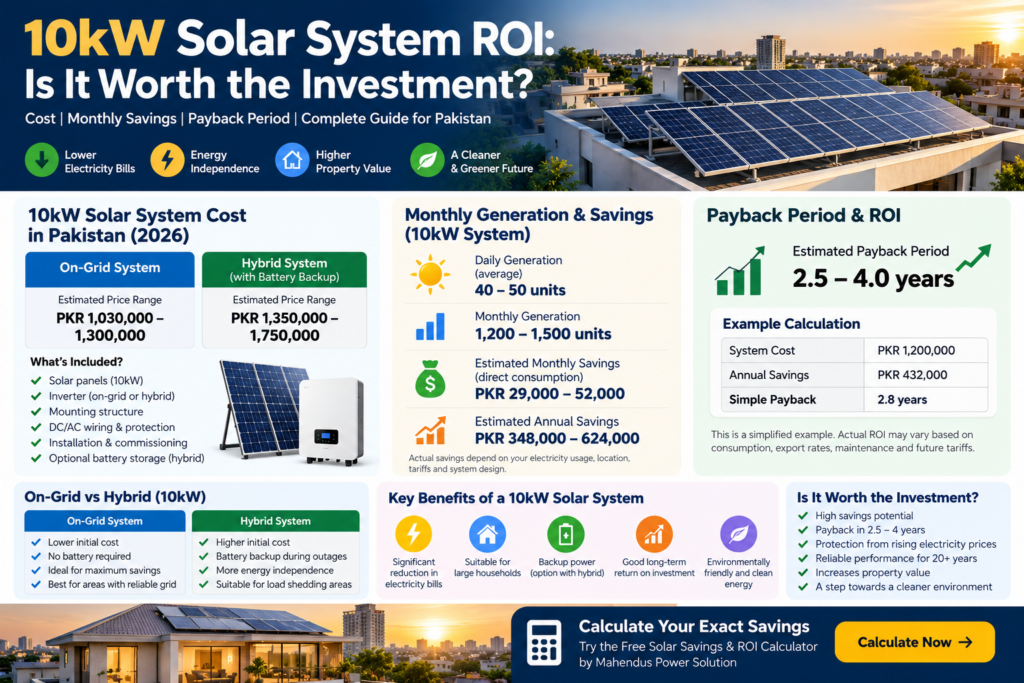
The installation cost of a 10kW solar system depends on whether you choose an on-grid or hybrid configuration.
Current published October 2026 market assessments indicate the following broad planning ranges.
| System Type | Estimated Installed Cost |
|---|---|
| 10kW On-Grid Solar System | PKR 950,000–1,300,000 |
| 10kW Hybrid with approximately 10kWh lithium storage | PKR 1,500,000–1,900,000 |
| 10kW Hybrid with approximately 15–16kWh lithium storage | PKR 1,600,000–2,400,000 |
These are indicative market ranges rather than fixed Mahendus Power Solution quotations. Battery capacity, inverter type, equipment quality and installation conditions can produce substantial price differences.
Solar panels: High-efficiency panels with strong warranties may cost more than lower-priced alternatives.
Inverter: An on-grid inverter is generally less expensive than a comparable hybrid inverter with battery management capabilities.
Battery storage: Lithium batteries significantly increase the initial cost but can provide backup power and additional energy flexibility.
Mounting structure: Rooftop height, shading, wind exposure, and installation design affect structural requirements.
Protection and wiring: Proper breakers, isolators, surge protection, cables, and grounding contribute to safe operation.
Installation and approvals: Labor, commissioning, technical assessments, and applicable utility connection requirements affect the final price.
Before making a purchase, request an itemized quotation specifying equipment brands, rated capacities, warranties and all included installation services.
Solar electricity generation is measured in kilowatt-hours (kWh), commonly called electricity units in Pakistan.
The amount of electricity a 10kW system produces depends on:
Geographical location
Solar irradiance
Panel orientation and tilt
Temperature
Dust accumulation
Rooftop shading
Inverter and electrical losses
Seasonal weather conditions
For initial planning, a well-positioned 10kW system in Pakistan may generate approximately 1,100–1,600 kWh in an average month, depending on location and performance.
These figures represent a broad range rather than guaranteed monthly production.
| Scenario | Daily Average | Monthly Generation |
|---|---|---|
| Lower generation | 35 kWh | 1,050 units |
| Moderate generation | 40 kWh | 1,200 units |
| Higher generation | 50 kWh | 1,500 units |
A 10kW system may produce more electricity during favorable sunny periods and less during cloudy weather or seasons with reduced sunlight.
Solar conditions differ across Pakistan.
For example, published long-term solar resource assessments indicate average annual photovoltaic generation potential per installed kWp of approximately:
| City | Annual Solar Yield per kWp | Approximate 10kW Annual Output |
|---|---|---|
| Lahore | 1,411 kWh | 14,110 kWh |
| Islamabad | 1,501 kWh | 15,010 kWh |
| Hyderabad | 1,715 kWh | 17,150 kWh |
| Quetta | 1,921 kWh | 19,210 kWh |
These are modeled long-term solar resource figures under specified assumptions, not guaranteed rooftop output. Actual residential systems may produce less because of roof orientation, shading, or installation losses.
Accurate generation forecasting should use a site-specific solar assessment.
The financial benefit of solar depends on how much electricity is consumed directly and how exported electricity is compensated.
A system that generates 1,200 units per month does not necessarily save the retail value of all 1,200 units.
Electricity used directly may replace grid electricity purchased at retail rates, while electricity exported under an eligible net-billing arrangement is credited at the applicable export rate.
Let’s examine an example.
Assume the following:
| Factor | Example |
|---|---|
| Solar system capacity | 10kW |
| Monthly solar generation | 1,200 units |
| Direct self-consumption | 70% |
| Solar electricity consumed directly | 840 units |
| Electricity exported | 360 units |
| Assumed avoided retail rate | PKR 35/unit |
| Illustrative export credit rate | PKR 11/unit |
Savings from direct consumption:
840 × 35 = PKR 29,400
Estimated export credits:
360 × 11 = PKR 3,960
Total estimated monthly financial benefit:
PKR 29,400 + PKR 3,960 = PKR 33,360
That represents approximately PKR 400,320 annually before operating costs and future adjustments.
The rates used here are illustrative calculation assumptions, not a statement of the exact tariff applicable to every electricity customer.
The example assumes all 360 surplus units can be exported and credited under an approved arrangement. Without export eligibility, those credits should not be included.
Fixed charges, taxes, tariff structures, seasonal consumption differences, and any remaining imported electricity may also affect the final bill.
One of the most important factors in solar profitability is how much generated electricity you use directly.
Under Pakistan’s 2026 net-billing framework, electricity exported to the grid can have a different financial value from electricity purchased from the grid.
Let’s compare three households using the same 10kW solar system.
Assumptions:
Monthly generation: 1,200 units
Avoided grid electricity value: PKR 35/unit
Export compensation: PKR 11/unit
All surplus electricity is eligible for export
| Self-Consumption | Monthly Financial Benefit |
|---|---|
| 40% | PKR 24,720 |
| 70% | PKR 33,360 |
| 90% | PKR 39,120 |
Although every scenario generates the same 1,200 electricity units, the financial benefit changes significantly.
A household or business that operates more appliances during the day can often extract greater value from its solar generation.
This explains why commercial properties with regular daytime operating hours may find solar particularly attractive.
The payback period measures how many years it may take to recover the original investment through energy-related financial benefits.
A simplified calculation is:
Simple Payback Period = Initial System Cost ÷ Annual Net Savings
Assume:
Installation cost: PKR 1,150,000
Monthly financial benefit: PKR 33,360
Annual benefit before operating costs: PKR 400,320
The calculation is:
1,150,000 ÷ 400,320 = approximately 2.9 years.
This represents an optimistic simplified scenario based on the specified assumptions, including relatively high direct consumption and approved export credits.
It excludes maintenance, system degradation, financing, equipment replacement, and changes in tariffs.
Assuming a PKR 1,150,000 installation cost:
| Solar Self-Consumption | Annual Benefit | Simplified Payback |
|---|---|---|
| 40% | PKR 296,640 | 3.9 years |
| 70% | PKR 400,320 | 2.9 years |
| 90% | PKR 469,440 | 2.4 years |
These are mathematical illustrations, not guaranteed customer outcomes.
For households that export large volumes of electricity, face lower avoided electricity rates, or incur higher system costs, real payback periods can be substantially longer.
Therefore, it’s important to calculate a property-specific solar return rather than relying on advertised payback claims.
Use the Mahendus Solar Savings & ROI Calculator to explore estimated costs and savings.
Yes, and it is especially important for larger residential solar systems.
Pakistan’s NEPRA Prosumer Regulations 2026 introduced a net-billing framework for new eligible installations, with subsequent amendments notified during the year.
Under this arrangement, electricity imported from the utility and electricity exported to the utility are billed or credited using their respective applicable rates.
This differs from assuming every exported electricity unit offsets an imported electricity unit at the same retail rate.
A larger system may produce significant surplus electricity during the day.
If your property uses only a small share of that generation directly, your return may depend heavily on export compensation.
A property with substantial daytime consumption may achieve a stronger return because more solar power directly replaces electricity purchased from the grid.
For this reason, the financially optimal system size should be based on real electricity usage patterns rather than monthly bills alone.
Before purchasing a solar system, confirm current connection eligibility, export-credit arrangements, sanctioned-load requirements, and any applicable agreement provisions with your distribution company.
Customers with existing approved agreements should check the rules applicable to their particular contracts.
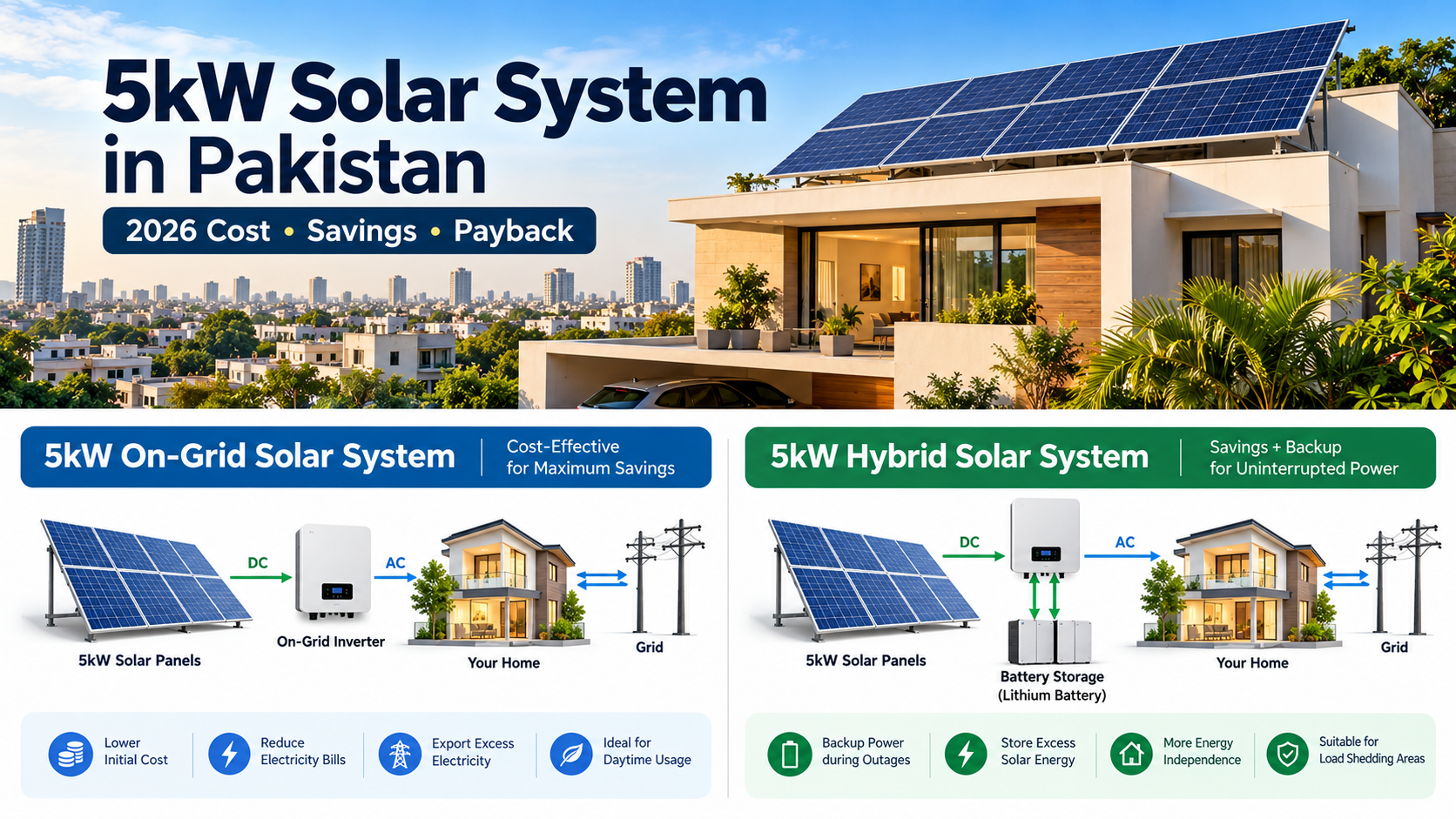
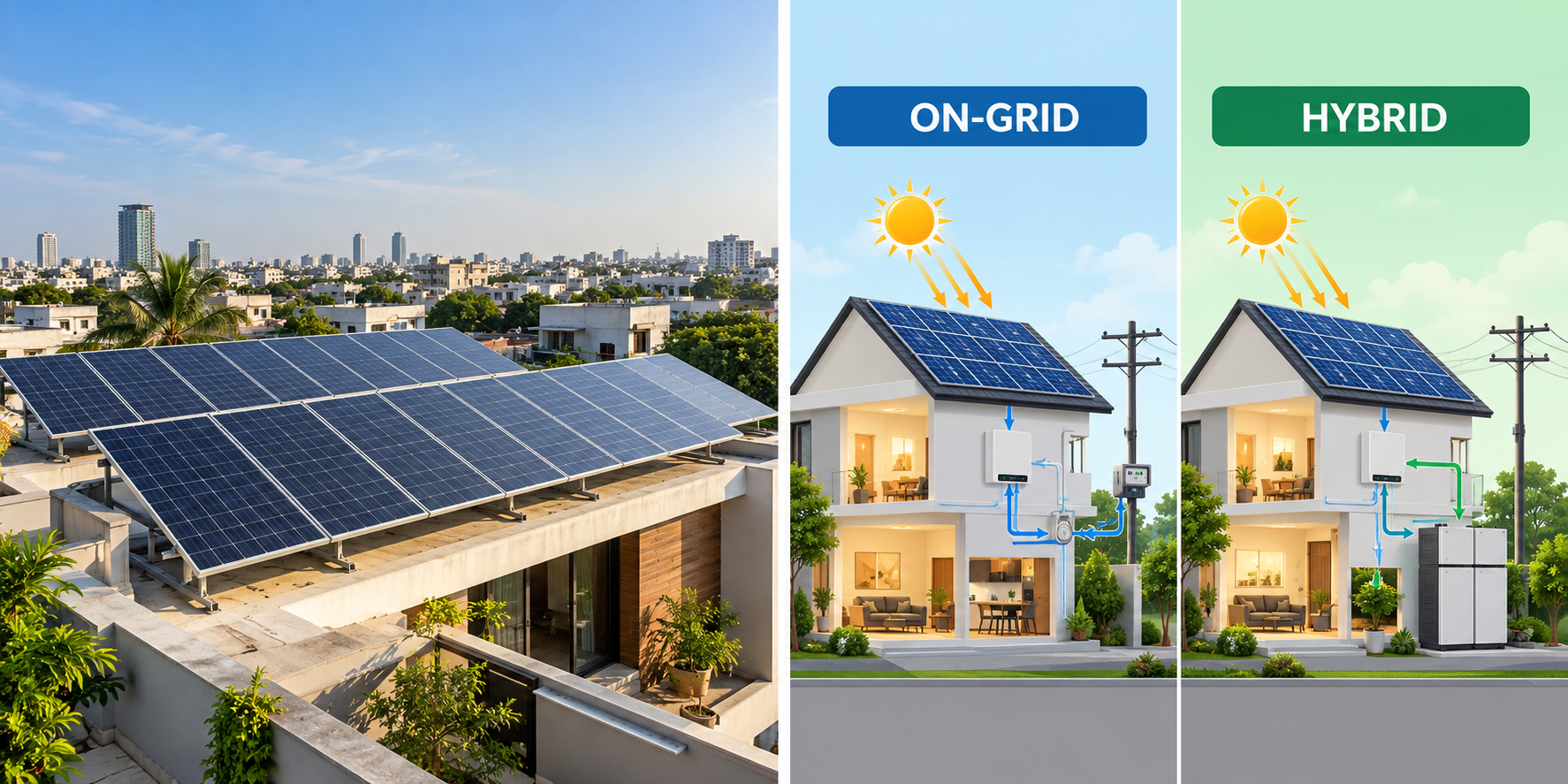
A 10kW solar system can be installed in different configurations depending on financial and electricity-backup requirements.
An on-grid system connects to the utility network without relying on battery storage.
Advantages:
Generally lower installation cost
No battery replacement expenses
Attractive for high daytime electricity consumption
Less equipment complexity
Potential to receive export credits where eligible
Limitations:
Standard grid-tied systems shut down during grid outages.
Electricity is purchased from the grid when solar output is insufficient.
Financial returns depend on applicable billing arrangements.
A hybrid system combines solar generation with battery storage and compatible inverter equipment.
Advantages:
Backup power during outages when correctly configured
Stores some electricity for nighttime or emergency use
More flexibility for managing energy consumption
Can reduce dependence on grid power for selected loads
Limitations:
Higher upfront installation cost
Battery replacement may eventually be required
Charging and discharging involve energy losses
More complex system design and maintenance
| Feature | On-Grid | Hybrid |
|---|---|---|
| Installation cost | Lower | Higher |
| Batteries | Not required | Usually included |
| Backup during load shedding | No | Yes, if configured |
| Equipment complexity | Lower | Higher |
| Battery replacement | No | Possible |
| Suitable for | Electricity savings | Savings and backup |
If your main objective is reducing electricity costs, an on-grid system may offer a simpler financial case.
If frequent electricity outages affect your household or business operations, a hybrid system may deliver value beyond direct electricity savings.
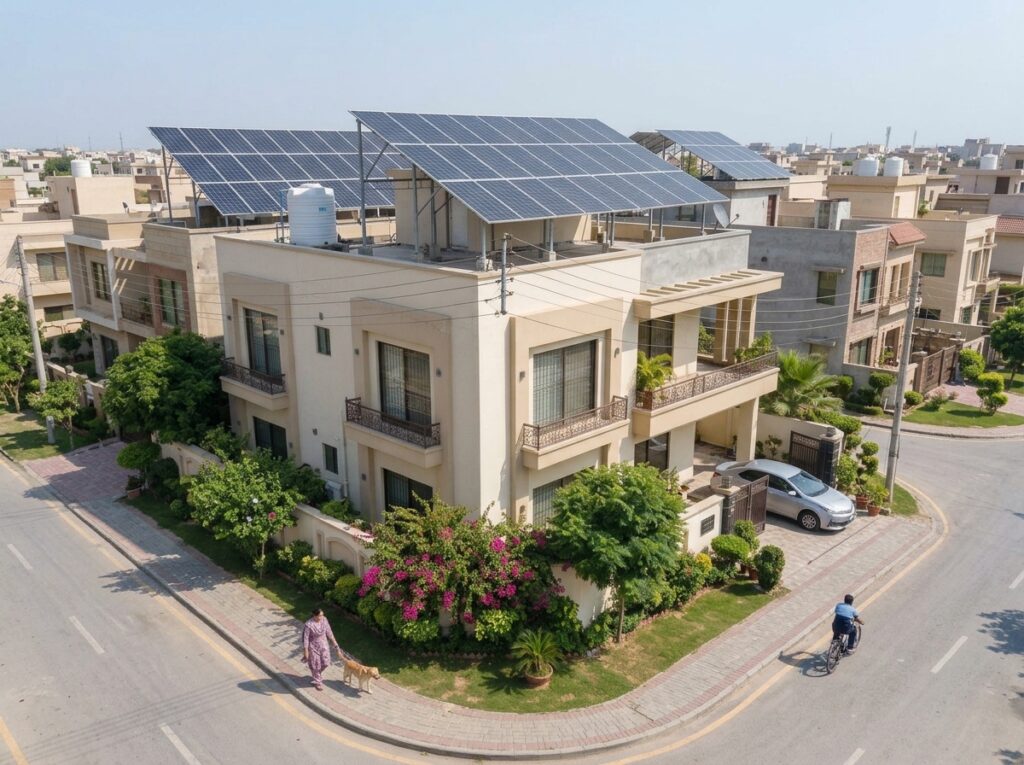
A 10kW solar system can support many household appliances simultaneously during favorable sunlight conditions.
For example, a large house may operate multiple inverter air conditioners, fans, refrigerators, lighting, televisions, computers, and other appliances.
However, whether it can power your entire home depends on instantaneous electricity demand.
| Appliance | Illustrative Running Load |
|---|---|
| Three inverter air conditioners | 2,700–5,400W combined |
| Refrigerator | 100–250W |
| Six ceiling fans | 300–540W combined |
| LED lighting | 100–200W combined |
| Television and internet equipment | 100–200W |
| Water pump | 500–1,500W |
Power requirements vary significantly by appliance model and operating conditions.
A 10kW system cannot be assumed to deliver its rated output continuously. Inverter output limitations, appliance startup loads, roof shading, and weather must be considered.
For power during outages or after sunset, the system also requires appropriate backup capability and sufficient battery storage.
A typical 10kW rooftop installation may need approximately 500–800 square feet of usable roof area, depending on panel dimensions, structural layout, tilt, access requirements, and shading.
The exact requirement should be established from the selected panels’ physical dimensions and a rooftop survey.
Water tanks, neighboring structures, ventilation equipment, and roof access paths can reduce usable installation space.
A professional installation design should consider safety, structural loading, and long-term maintenance access.
Solar panels can continue producing electricity for many years when properly installed and maintained.
However, long-term financial projections must account for more than the first-year electricity savings.
Important factors include:
Solar panel degradation: Panel output typically declines gradually with age.
Maintenance: Cleaning, inspection, and electrical maintenance may incur ongoing expenses.
Inverter replacement: The inverter may require repair or replacement before the panels reach the end of their useful service life.
Battery replacement: Hybrid systems may need battery replacement depending on battery chemistry, cycling and operating conditions.
Electricity tariffs: Future grid tariffs and export compensation may change.
Financing: If the installation is purchased using a loan, financing charges affect investment returns.
Opportunity cost: Money invested in solar could alternatively be used for other investments.
A proper long-term assessment should calculate cash flows over the intended ownership period rather than multiplying first-year savings by 20 or 25 years without adjustments.
A 10kW system may be suitable for:
Homes with several air conditioners and significant electricity consumption may benefit from larger solar capacity.
Businesses operating during daylight hours can often consume a substantial share of the electricity generated.
Retail establishments, workshops, and other commercial properties may benefit when their operational electricity demand overlaps with solar production.
Where load shedding disrupts daily activities, a properly designed hybrid system may offer additional practical value.
However, not every property needs a 10kW installation.
A smaller system may offer better financial returns if electricity consumption is relatively low.
Schedule suitable appliances and business operations during solar generation hours whenever practical.
Avoid installing more solar capacity than your property can use economically.
Select panels, inverters, mounting systems, and electrical protection components based on performance, warranties, safety, and long-term reliability.
Use inverter monitoring data to identify unexpected production drops, faults, or performance issues.
Consider actual outage frequency, backup loads, electricity consumption patterns, and battery replacement costs before investing in large energy storage systems.
A 10kW solar system can offer strong long-term financial value, particularly for homes and businesses with substantial daytime electricity consumption.
However, it is not automatically the most economical solar option for every property.
A larger installation requires greater upfront investment, and the returns depend heavily on electricity usage patterns and billing rules.
Before purchasing, review:
Your current electricity bills
Daytime and nighttime electricity consumption
Rooftop space and shading
Installation cost and equipment quality
Applicable utility export arrangements
Maintenance and replacement expenses
The value of backup power during outages
For a realistic investment decision, compare multiple quotations and use a personalized savings model.
Recent October 2026 market assessments place many 10kW on-grid installations in a broad PKR 950,000–1,300,000 range. Battery-equipped hybrid systems generally cost more, with the exact price depending on storage capacity and equipment.
A well-positioned 10kW system may generate approximately 35–50 units daily under illustrative conditions, although actual output varies by location, season, weather, shading, and equipment.
Savings depend on how much solar energy is used directly and the value of eligible exports. In the illustrative 70% self-consumption example in this guide, the monthly financial benefit is PKR 33,360 before operating costs and adjustments.
Payback depends on installation cost, electricity consumption, retail tariffs, export credits, and ongoing expenses. Some favorable simplified examples suggest a few years, while less favorable configurations can require substantially longer.
It may be appropriate for a large house with substantial electricity usage, but property size alone is not a reliable way to select solar capacity. A load assessment is essential.
It may support three efficient inverter ACs during favorable conditions, subject to their actual power consumption, other household loads, and the inverter’s available output.
A hybrid system provides battery backup when properly configured but costs more. An on-grid system can be more economical when backup power is not a priority.
Approximately 17 panels rated at 585W produce 9.95kW of rated capacity. Other configurations may require different panel counts.
It can reduce financial returns for properties that export a large share of their solar generation, because eligible exports are valued differently from electricity purchased at retail tariffs.
Use the free Mahendus Solar Savings & ROI Calculator to estimate potential savings and compare solar investment options.
A 10kW solar installation can be a valuable long-term investment for Pakistani homeowners and businesses with substantial daytime electricity demand.
Its main benefits include reduced grid electricity consumption, more predictable energy expenses, and the option to add backup storage.
But an attractive return depends on proper system sizing, realistic assumptions, installation quality, and current utility regulations.
Rather than relying on generalized savings promises, evaluate the financial performance of a system designed specifically for your property.
Mahendus Power Solution offers a free online calculator to help you explore estimated system costs, monthly savings, investment payback periods, and on-grid versus hybrid solar options.
Calculate Your Solar Savings & ROI for Free
Make a more informed decision before investing in solar energy.
For a detailed system recommendation and installation quotation, contact Mahendus Power Solution for a professional site assessment.